

 Scroll down
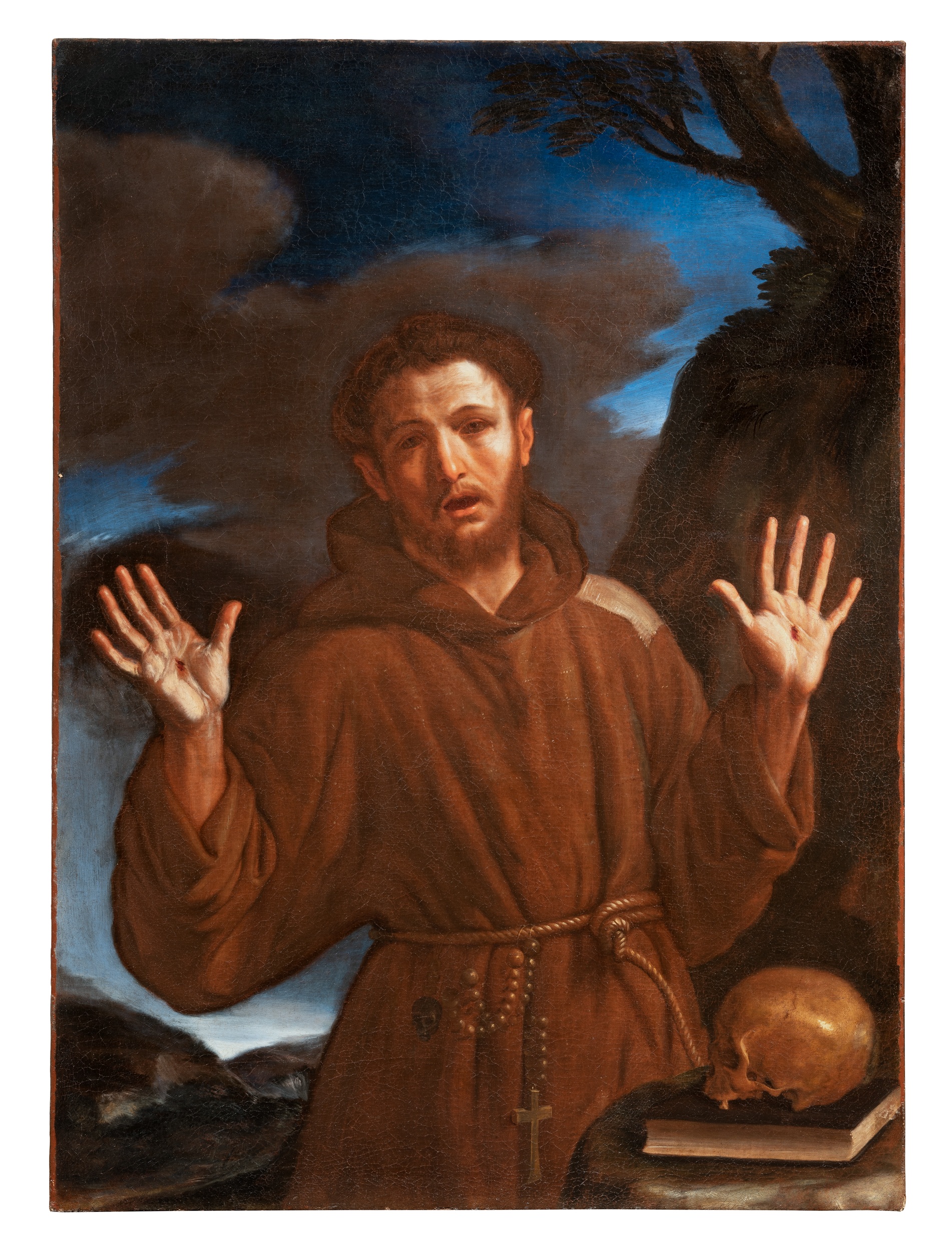
 Guercino (Giovanni Francesco Barbieri, known as Guercino), Saint Francis in Ecstasy, c. 1660. Oil on canvas, 129 × 94 cm. Before us is an outstanding example of Guercino’s mature work, by one of the foremost representatives of seventeenth-century Bolognese Baroque painting. The depiction of Saint Francis at the moment of mystical illumination is rendered with pronounced emotional intensity and a powerful sense of spiritual concentration. The raised arms with open palms, the gaze directed toward the viewer with tear-filled eyes, the parted mouth, and the knitted brows convey not a theatrical effect, but an inwardly experienced, profoundly personal encounter with the Divine.
The composition is structured along an axis of vertical ascent: from the stone with the skull and book, to the figure of the saint, and then upward toward the bright opening in the nocturnal sky. This structure, like the choice of iconography, accords with post-Tridentine religious aesthetics, in which contemplative devotion is expressed through the body and gesture while retaining severity and focus. The subtle modelling of the draperies, the tense silhouette of the hands, and the facial type correspond to other images of Francis in Guercino’s oeuvre, although the treatment here is distinguished by greater expressiveness and a freer handling of paint.
As Pierluigi Carofano has established, the composition repeats the figure of Francis from the altarpiece of the Assumption of the Virgin in Lucca, in the church of Santa Maria Forisportam, 1642–43, for which the same preparatory drawing was used. However, the colouristic range and painterly manner of the present work are richer and freer, allowing it to be dated somewhat later. According to the Libro dei conti, around 1660 the artist did indeed execute a “mezza figura di San Francesco” for the Duke of Massa, with which the present painting may be identified. Claudio Strinati emphasizes that the level of execution, the expressiveness of the gestures, and the psychological depth exclude workshop authorship and confirm the hand of Guercino himself. This opinion is also supported by Emilio Negro, who compares the painting with Guercino’s late works of the 1650s and 1660s, noting analogous compositional and colouristic solutions, particularly in Saint Clare and Saint Catherine of Alexandria from Reggio Emilia.
Technical and scientific examination by Dr Gianluca Poldi revealed the use of pigments characteristic of Guercino’s mature practice: ultramarine, vermilion, ochres, lead white, and carmine lake. The painting was executed over a dark ground, with precise painterly annotations in the areas of the hands and draperies, detectable through infrared reflectography. These findings confirm a high degree of correspondence with the master’s autograph technique.
Thus, the painting’s pictorial and technical characteristics, its iconography, scale, and documentary evidence allow it to be recognized, with a high degree of confidence, as an authentic work by Guercino, created in the late period of his career — at the intersection of the public, rhetorical image and intimate, concentrated religious meditation.
 Back
Back 

